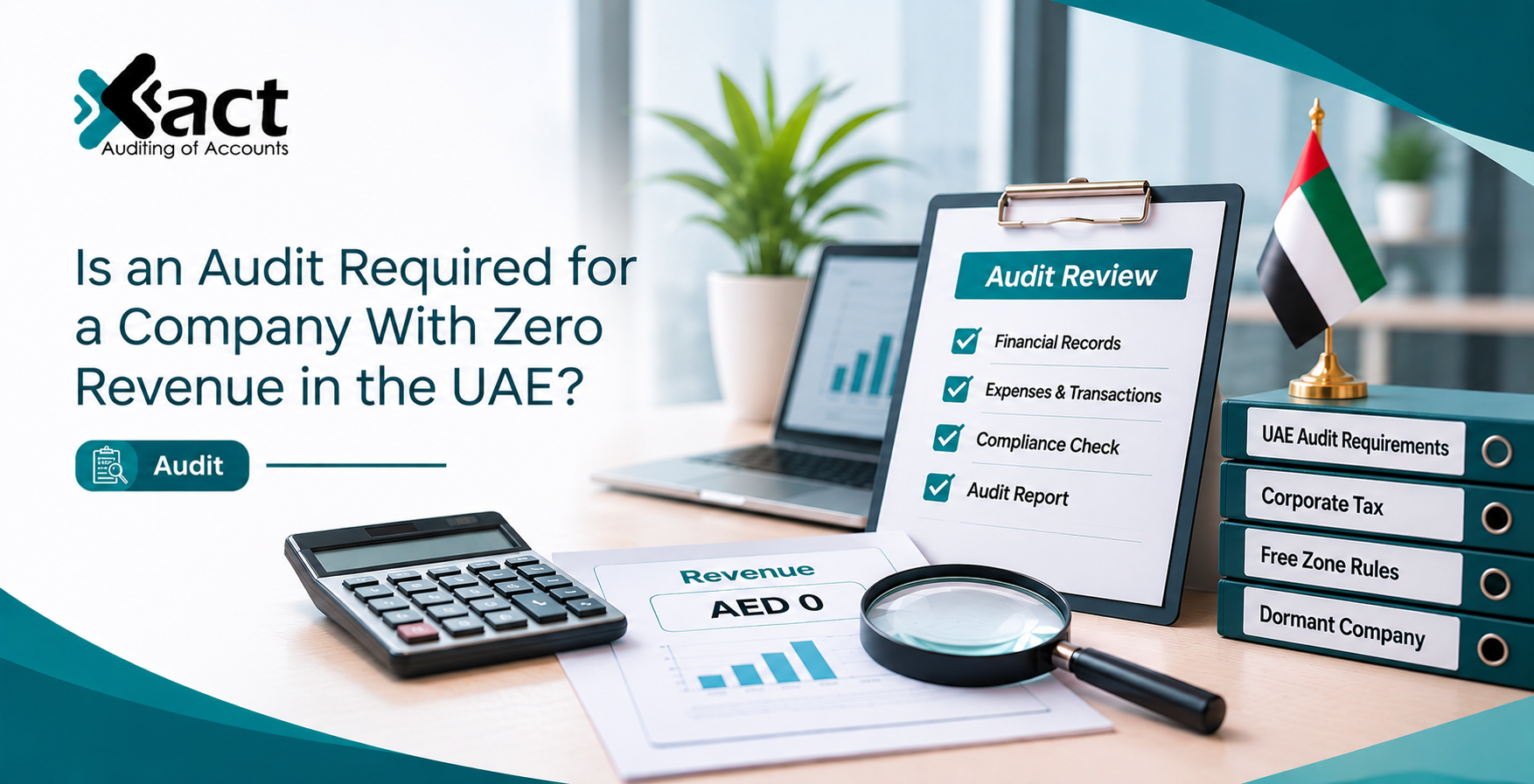
A company can go an entire year without making a single sale and still have an audit bill to pay. Sounds strange? Not really. In the UAE, audit requirements don’t depend on revenue alone. The company’s legal structure, free zone rules, and Corporate Tax status can all affect whether an audit is required.
This is where many business owners get confused. They assume that no sales means no audit. However, a company may still have rent, license fees, bank transactions, shareholder funding, and other expenses to report.
So, does a UAE company with zero revenue need an audit? In many cases, yes. Let’s look at what the rules actually say and when a business may qualify for an exemption.
Does UAE Law Require an Audit When a Company Has No Revenue?
Under Article 27 of the UAE Commercial Companies Law, every limited liability company (LLC) and joint-stock company must appoint an auditor to examine its accounts each year.
Notice something important here? The law does not say that a company must earn a certain amount before this requirement applies.
For example, imagine someone opens an LLC in Dubai but doesn’t start trading during the first year. The company makes no sales, but the owner still pays for the trade license, office rent, and other setup costs.
The business has no revenue, but it has financial records. Under Article 27, its annual audit obligation still applies because it is an LLC.
The same requirement applies to joint-stock companies. Other legal forms may have different requirements, so the company’s structure matters. Businesses that need an independent review of their accounts can explore Xact Auditing’s audit services in Dubai to understand the available audit services.
What About Companies Registered in Free Zones?
Free zone companies need a closer look. Each authority may have its own rules for annual accounts, audits, and dormant businesses.
Some free zones require companies to submit audited financial statements as part of their annual compliance process. Others provide specific exemptions for companies that meet certain dormancy conditions.
DMCC is a useful example. Under Article 78.11 of its Company Regulations, a company can qualify for an audit exemption if it has remained dormant throughout the entire financial year. Shareholders holding at least 10% of the issued share capital can still request an audit under the conditions in Article 78.12. See the DMCC Company Regulations.
However, this exemption does not apply to every free zone in the UAE. A company in Ajman Free Zone, for example, should check the requirements set by its own authority.
The same applies to businesses operating in SAIF Zone. Companies should check the applicable reporting rules and use an auditor accepted by the relevant authority where required. Xact Auditing also provides SAIF Zone approved auditor services for companies that need audit assistance in Sharjah Airport International Free Zone.
The important point is that zero revenue does not automatically make a free zone company dormant or exempt from an audit.
Does Corporate Tax Require an Audit for a Zero-Revenue Company?
UAE Corporate Tax has its own rules for audited financial statements. These rules are separate from the annual audit requirements under company law.
For tax periods starting on or after January 1, 2025, Ministerial Decision No. 84 of 2025 sets out three important categories.
Business category | Audit requirement |
Taxable person that is not part of a Tax Group | Audited financial statements are required if revenue exceeds AED 50 million during the tax period |
Qualifying Free Zone Person (QFZP) | Audited financial statements are required regardless of revenue |
Corporate Tax Group | Must prepare audited special-purpose aggregated financial statements |
Source: Ministerial Decision No. 84 of 2025.
This creates an important difference between two companies with no sales.
A mainland business that is not part of a Tax Group or a QFZP may fall below the AED 50 million Corporate Tax audit threshold. However, if it is an LLC, its separate annual audit obligation under company law still applies.
A Qualifying Free Zone Person has a different position. Even if it earns no revenue, it must maintain audited financial statements to meet the QFZP requirements.
Tax Groups also have a separate reporting obligation. Under FTA Decision No. 7 of 2025, they must prepare audited special-purpose aggregated financial statements.
Businesses preparing their accounts for Corporate Tax purposes can also review Xact’s financial audit services for Corporate Tax filing to understand how financial statements fit into their filing requirements.
Zero Revenue and Dormant Status Are Not the Same
This is probably the most important distinction for a business owner to understand.
A company can have no sales but still be active. For example, it might:
- Pay monthly office rent.
- Renew its trade license.
- Receive money from shareholders.
- Pay employees or suppliers.
- Purchase equipment.
- Make loan repayments.
None of these activities necessarily generates revenue. However, they create financial transactions that need to be recorded.
A dormant company is a different case. Its status depends on the rules of the relevant authority and whether it meets the conditions for dormancy.
Consider a company that hasn’t sold anything all year but has paid AED 40,000 in rent and license fees. Calling it a zero-revenue company would be correct. Calling it dormant without checking the applicable rules would be another matter.
What Does an Auditor Check When There Are No Sales?
An audit doesn’t become unnecessary just because the sales section of a company’s accounts shows zero.
The auditor still needs to examine the financial information and check whether the accounts present a fair picture of the business.
This may include:
- Bank balances: Checking the money held in company accounts and reviewing bank transactions.
- Shareholder funding: Confirming whether money received from owners represents share capital or a loan.
- Business expenses: Reviewing rent, license fees, salaries, and other payments.
- Company assets: Checking equipment, office furniture, and other assets recorded in the accounts.
- Outstanding liabilities: Reviewing unpaid bills, loans, and other amounts the company owes.
For instance, if an owner transfers AED 100,000 into the company’s bank account, the business needs to record that amount correctly. The money may represent a shareholder loan or capital contribution. It should not be treated as sales income simply because it entered the bank account.
Does a Company With Zero Revenue Still Need to File a Corporate Tax Return?
Yes, if it has a Corporate Tax filing obligation. Having no revenue does not automatically remove the requirement to submit a return.
An audit and a Corporate Tax return are two separate matters. A company may need to file its return even when it does not fall within the categories that require audited financial statements under Ministerial Decision No. 84 of 2025.
Businesses preparing their tax returns should also understand when audited accounts are needed. Xact’s audit services for Corporate Tax filing in the UAE can help companies address the financial reporting requirements relevant to their tax filing.
Business owners should check their registration and filing status rather than assume that an inactive year means no tax responsibilities.
Need an Audit for Your UAE Company?
Not every company with zero revenue follows the same rules. An LLC, a free zone company, and a Qualifying Free Zone Person may have very different obligations.
Xact Auditing helps businesses review their financial records and understand the audit requirements that apply to their company. Whether the business has just been established or has not started trading, getting the right advice can help avoid missed compliance requirements.
Contact Xact Auditing to discuss your company’s audit requirements.



 Previous Post