UAE eInvoicing: Timeline and Compliance Requirements
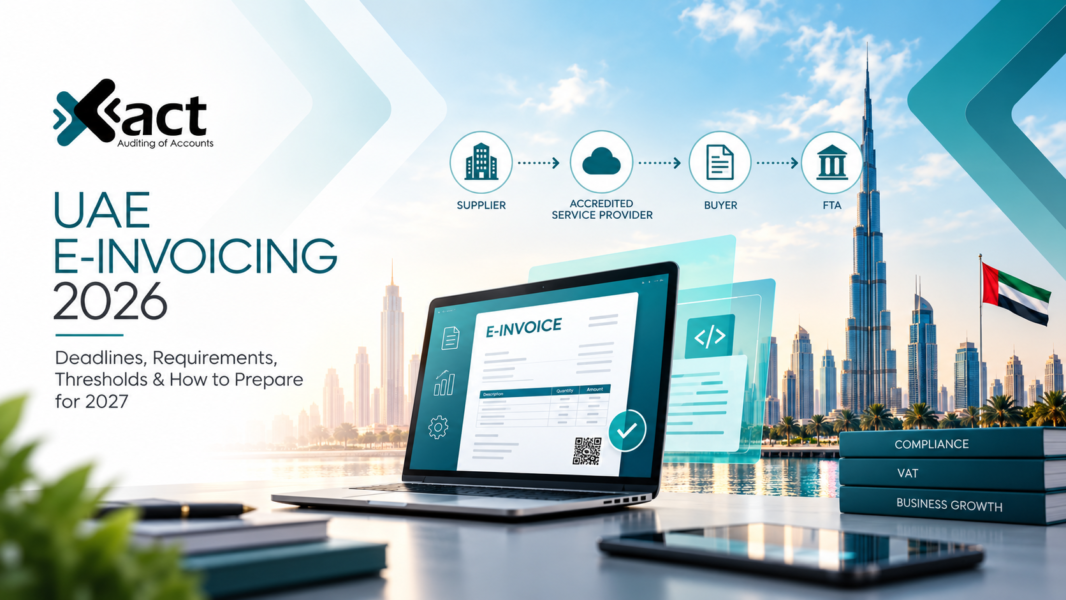
Xact Auditing outlines the UAE eInvoicing timeline, key deadlines and compliance requirements to help businesses prepare for mandatory implementation. The UAE e-invoicing system is being introduced in phases, and businesses now need to prepare according to their implementation timeline.
- Businesses with annual revenue of AED 50 million or more must appoint an Accredited Service Provider (ASP) by 30 October 2026 and implement e-invoicing from 1 January 2027.
- Businesses with annual revenue below AED 50 million have until 31 March 2027 to appoint an ASP and must implement the system from 1 July 2027.
The first deadline is particularly important because the original ASP appointment date for businesses with revenue of AED 50 million or more was changed from 31 July 2026 to 30 October 2026 through Ministerial Resolution No. 66 of 2026. The mandatory implementation date of 1 January 2027 remains unchanged.
That means the extension should not be treated as an extension of the entire implementation project. For businesses in the first phase, there is still a short window between appointing an ASP and going live.
If your business operates in the UAE, now is the time to understand where you stand, which deadline applies to you, and what needs to change before your invoices start moving through the new system.
UAE E-Invoicing Timelines
The UAE e-invoicing deadline depends on the revenue category and type of entity.
Large Businesses (AED 50M+ revenue)
- Accredited Service Provider (ASP) appointment by October 30, 2026
- E-invoicing goes live on January 1, 2027.
Small and Medium Businesses SMEs (under AED 50M revenue)
- Accredited Service Provider (ASP) appointment by March 31, 2027
- E-invoicing goes live on July 1, 2027.
Government Entities
- Accredited Service Provider (ASP) appointment by March 31, 2027
- E-invoicing goes live on October 1, 2027.
Which UAE Businesses Are Subject to E-Invoicing?
Two main types of business transactions are subject to UAE eInvoicing:
- Business-to-Business (B2B) – Transactions between businesses.
- Business-to-Government (B2G) – Transactions between businesses and government entities.
Business-to-business (B2B) and business-to-government (B2G) transactions fall within the UAE e-invoicing framework, subject to applicable exclusions and requirements.
The same framework applies to relevant transactions involving government entities. Businesses supplying goods or services to other businesses or government entities should therefore consider e-invoicing as part of their compliance planning and implementation.
This means companies should review their actual transaction flows instead of assuming that the rules apply only to VAT-registered entities.
Which UAE Businesses Are Exempt from E-Invoicing?
Business-to-Consumer (B2C) transactions involving natural persons who are not conducting business are currently outside the mandatory Electronic Invoicing System.
However, businesses should not interpret this as a permanent exemption. The current legislation leaves scope for the treatment of B2C transactions to change through a future decision by the Federal Tax Authority (FTA).
For businesses with mixed B2B and B2C operations, this distinction makes it particularly important to identify which transactions fall within the current requirements.
How the UAE Five-Corner E-Invoicing Model Works?
The UAE eInvoicing framework uses the OpenPeppol standard and a five-corner model involving:
- Corner 1 – Supplier: Issues the structured electronic invoice.
- Corner 2 – Supplier’s ASP: Receives, validates and transmits the invoice through the eInvoicing network.
- Corner 3 – Buyer’s ASP: Receives and processes the invoice for the buyer.
- Corner 4 – Buyer: Receives the electronic invoice in a compatible system.
- Corner 5 – FTA: Receives the required transaction data for tax reporting and compliance purposes.
This model enables invoice data to be exchanged securely between suppliers and buyers while the required information is reported electronically to the FTA.
The five-corner model became operational during the UAE’s 2026 pilot phase, moving the eInvoicing programme from planning into practical implementation and testing.
What is an Accredited Services Provider (ASP) in UAE E-Invoicing?
The Ministry has established accreditation requirements for service providers, including Peppol certification, technical, information security, business continuity, and experience requirements.
Businesses should always verify the provider’s accreditation through official UAE channels rather than relying only on a software company’s marketing claims.
UAE e-Invoicing Implementation
The best approach is to treat e-invoicing as a business-readiness project rather than a software purchase.
Phase 1 – Determine Whether Your Business Is in Scope
Start by reviewing your business activities and transaction types.
Do not rely only on VAT registration status. The UAE framework can apply to persons conducting business regardless of whether they are VAT registered.
Phase 2 – Check Your Revenue Category
Identify the revenue category that determines your implementation phase.
If your revenue is AED 50 million or more, the 30 October 2026 ASP deadline and 1 January 2027 implementation date are particularly important.
Phase 3 – Review Your Current Invoicing Process
Document how invoices are currently created, approved, issued, received and stored.
Look for manual data entry, spreadsheets, disconnected systems and processes that depend heavily on email or PDF documents.
Phase 4 – Check Your Accounting or ERP Software
Ask whether your current accounting or ERP system can support the required e-invoicing process.
A software review should happen before choosing an ASP because the two systems need to work together effectively.
Phase 5 – Select an Accredited Service Provider
Review the official list of Accredited Service Providers and compare providers based on integration, security, support and business requirements.
The cheapest provider is not necessarily the least expensive option in the long run if the integration creates operational problems.
Phase 6 – Review Your Customer and Supplier Data
Structured e-invoicing makes data quality much more important.
Review customer and supplier records, tax information, invoice details and other required fields before implementation.
Phase 7 – Prepare for E-Invoice Data Requirements
The Ministry of Finance has published mandatory fields for electronic invoices.
These include information such as invoice number, invoice date, invoice type, currency and other transaction-related data.
Businesses should identify any missing or inconsistent information well before testing begins.
Phase 8 – Test the System Before the Mandatory Date
Do not wait until the first mandatory invoice to discover that something does not work.
Testing should cover invoice creation, transmission, receiving, data validation, corrections and relevant exception scenarios.
Phase 9 – Train Your Finance and Accounting Team
The change affects more than software.
Finance and accounting employees should understand the new invoice process, responsibilities, approval procedures and what to do when an exception or system issue occurs.
Phase 10 – Establish an Internal E-Invoicing Process
Finally, document who is responsible for monitoring the process, managing data, communicating with the ASP and handling compliance-related issues.
A system is only as effective as the process built around it.
Does a PDF Invoice Qualify as an E-Invoice in the UAE?
No. The Ministry of Finance specifically states that PDFs, Word documents, images, scanned copies and emails are unstructured formats and do not qualify as eInvoices.
One of the most common misconceptions about UAE e-invoicing is that businesses are already compliant simply because they send invoices electronically.
A PDF invoice can still be useful for ordinary business communication, but it is not an eInvoice under the UAE Electronic Invoicing System.
How Xact Auditing Can Help With UAE E-Invoicing?
Xact Auditing can assist UAE businesses with eInvoicing readiness, compliance requirements and implementation planning. Our team can help assess your current invoicing processes and support you in preparing for the applicable eInvoicing deadlines.
For many businesses, the difficult part of e-invoicing is not understanding that invoices will become digital. It is understanding how the new requirements fit into their existing accounting, VAT, and financial processes.
Xact Auditing works across e-invoicing, accounting, bookkeeping, VAT, tax consultancy, and audit services, giving businesses access to support that goes beyond the technology itself.
Xact can help businesses review their current financial and invoicing processes, understand the compliance implications, assess their readiness, and identify areas that may need attention before implementation.
If you are unsure which UAE e-invoicing requirements apply to your business, what your implementation timeline looks like, or whether your current accounting processes are ready, professional guidance can help you identify the gaps before they become compliance problems.
Looking for e-invoicing services in UAE? Discuss your business requirements and the key steps needed to prepare for your applicable eInvoicing deadline by Contacting Xact Auditing.

Zuha is a content writer at Xact Auditing, specializing in UAE accounting, audit, VAT, and Corporate Tax content. She delivers research-driven, clear insights by simplifying complex regulatory and compliance topics for UAE businesses. Her work is developed in collaboration with chartered accountants and tax professionals, ensuring alignment with IFRS, ISA, and FTA regulations. Content is written by Zuha and reviewed by Xact Auditing’s audit, accountants and tax experts for accuracy and compliance.