Qualifying Free Zone Person (QFZP) UAE | Corporate Tax Guide
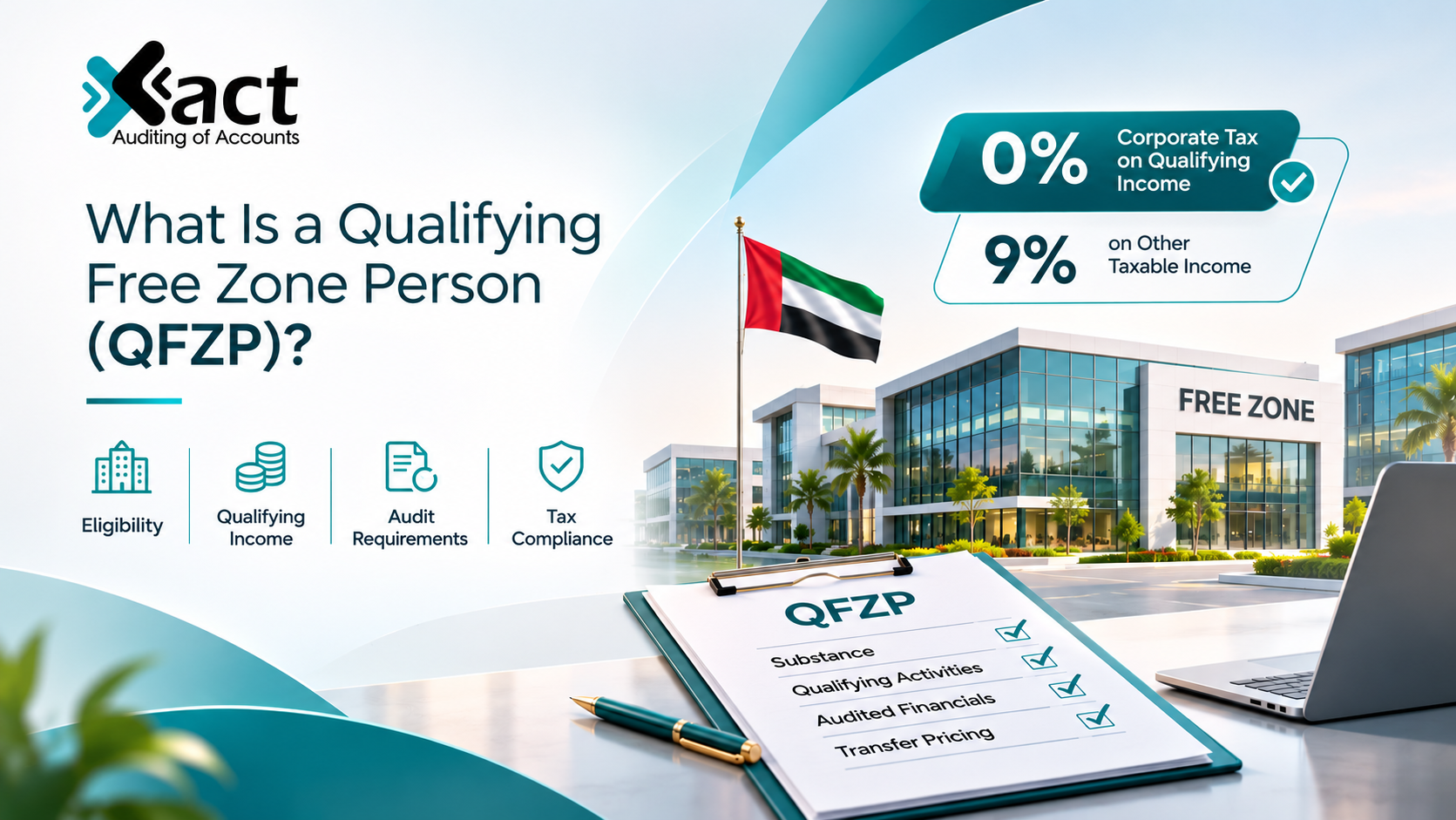
A Qualifying Free Zone Person (QFZP) in the UAE can benefit from 0% Corporate Tax on qualifying income. However, holding a Free Zone licence alone does not guarantee this benefit.
Businesses searching for Qualifying Free Zone Person UAE guidance should know that a Free Zone licence alone does not secure the 0% rate. A company must meet the statutory conditions throughout the relevant Tax Period and apply the rules to each income stream.
What Is a Qualifying Free Zone Person (QFZP) in the UAE?
A QFZP is a juridical Free Zone Person that meets Article 18 of the UAE Corporate Tax Law and related decisions. It may apply a 0% rate to Qualifying Income, while other taxable income may be subject to 9%. Businesses can also refer to Xact Auditing’s guide to Corporate Tax for Free Zone Companies in the UAE for a broader understanding of how the tax regime applies to Free Zone entities.
What Are the Benefits of Qualifying as a Free Zone Person?
The main benefit is 0% tax on qualifying profits. Other UAE Free Zone Tax Benefits include greater certainty for cross-border structures and a tax framework that can support investment, provided the business meets all conditions.
Conditions to Qualify as a Qualifying Free Zone Person
To meet the QFZP Requirements, a company must satisfy the following conditions and maintain supporting evidence.
Maintaining Adequate Substance in the UAE
The company must conduct its core income-generating activities in the Free Zone and maintain suitable employees, assets, and operating expenditure. Outsourcing may be permitted where the company adequately supervises the work.
Deriving Qualifying Income
Income must fall within the categories set by Cabinet Decision No. 100 of 2023. The customer’s location alone does not determine the treatment. The activity, transaction, and recipient must also meet the rules.
Maintaining Audited Financial Statements
Every QFZP must prepare audited financial statements, regardless of revenue. This requirement applies to Tax Periods starting on or after 1 January 2025.
Compliance with Transfer Pricing Requirements
Related-party transactions must follow the arm’s length principle. Businesses should retain agreements, pricing support, and transaction records. Master File and Local File obligations apply where the relevant thresholds and conditions are met.
Meeting the De Minimis Requirements
Non-qualifying revenue must not exceed the lower of 5% of total revenue or AED 5 million. Specific exclusions apply when calculating the threshold.
Not Electing to Be Subject to the Standard Corporate Tax Regime
A Free Zone Person may elect to use the standard regime. Once it makes that election, it cannot claim QFZP treatment for the relevant period under the applicable rules.
What Is Qualifying Income for a Free Zone Company?
Qualifying Income UAE refers to income that meets Cabinet Decision No. 100 of 2023 and the applicable ministerial decisions.
Transactions with Other Free Zone Persons
Income from another Free Zone Person can qualify where the recipient is the beneficial recipient and the transaction does not involve an Excluded Activity.
Transactions with Non-Free Zone Persons
Income from mainland or overseas customers may qualify when it arises from a listed Qualifying Activity and is not excluded. A mainland sale is therefore not automatically taxable at 9%.
Qualifying Activities Under UAE Corporate Tax
Under Ministerial Decision No. 229 of 2025, activities include manufacturing, processing, qualifying commodity trading, holding investments, ship operations, reinsurance, fund and wealth management, headquarter services, treasury and financing, aircraft financing and leasing, Designated Zone distribution, logistics and related ancillary activities.
Excluded Activities Under UAE Corporate Tax
Excluded activities include specified dealings with natural persons, banking, insurance, certain finance and leasing activities, and certain immovable property income. Exceptions apply, so businesses should classify each transaction before deciding its tax treatment.
What Is Non-Qualifying Income?
Non Qualifying Income UAE generally includes income that does not meet the qualifying-income rules. It may be taxed at 9%, subject to the de minimis rule and specific treatment for permanent establishments and immovable property.
What Happens If a Free Zone Company Fails to Meet QFZP Conditions?
A company loses QFZP status from the beginning of the Tax Period in which it fails a condition and for the next four Tax Periods. It must then apply the standard Corporate Tax rules.
Some businesses may decide to close their Free Zone entity rather than continue operating under a different tax structure. Companies registered with IFZA that are planning to cease operations can refer to Xact Auditing’s IFZA liquidation report services for information about the financial review and documentation required for company closure.
Is an Audit Mandatory for a Qualifying Free Zone Person?
Yes. Ministerial Decision No. 84 of 2025 requires every QFZP to maintain audited financial statements, without a minimum revenue threshold.
Corporate Tax Rate for Qualifying Free Zone Persons
The rate is 0% on Qualifying Income and 9% on other taxable income. The standard AED 375,000 threshold does not apply to a QFZP’s non-qualifying income. QFZPs are also not eligible for Small Business Relief UAE.
Corporate Tax Compliance Requirements for UAE Free Zone Companies
Corporate Tax Compliance UAE includes registration, accurate returns, records retained for seven years, audited statements, and transfer pricing support. Returns and payment are generally due within nine months after the Tax Period ends.
From 2026, qualifying Designated Zone distributors must also obtain an independent auditor’s agreed-upon procedures report under FTA Decision No. 6 of 2026. This additional requirement applies to the relevant distribution activity, not every Free Zone business.
How Xact Auditing Can Help UAE Free Zone Companies
Xact Auditing supports UAE Free Zone businesses with Corporate Tax and audit-related requirements, including:
- QFZP eligibility reviews: Assessing whether a company meets the conditions for Qualifying Free Zone Person status.
- Income classification: Reviewing revenue streams to identify qualifying and non-qualifying income.
- Audit preparation: Assisting with the preparation of financial records and mandatory audit requirements.
- Transfer pricing support: Reviewing related-party transactions and supporting documentation.
- Corporate Tax return assistance: Helping businesses prepare and meet their filing obligations.
Contact Xact Auditing before filing to discuss your requirements and identify potential compliance gaps.
Conclusion
The Qualifying Free Zone Person UAE regime offers a 0% rate on qualifying income, not a blanket exemption. Businesses should review their activities, revenue, substance, and audit requirements regularly. A reliable UAE Corporate Tax Guide and professional advice can help Free Zone businesses maintain compliance and protect their tax position.
Frequently Asked Questions
Yes. A company can qualify if it meets all applicable conditions and earns Qualifying Income. Free Zone registration alone is insufficient.
Yes. Every QFZP must maintain audited financial statements, even if its annual revenue is low.
Yes. Mainland transactions may qualify when they relate to a Qualifying Activity and meet the other conditions.
The limit is the lower of 5% of total revenue or AED 5 million, subject to prescribed exclusions.
Yes. Failing a condition can remove the status for the current and following four Tax Periods.
Yes. A QFZP must register, file a return and meet payment obligations even when all its income is taxed at 0%.

Zuha is a content writer at Xact Auditing, specializing in UAE accounting, audit, VAT, and Corporate Tax content. She delivers research-driven, clear insights by simplifying complex regulatory and compliance topics for UAE businesses. Her work is developed in collaboration with chartered accountants and tax professionals, ensuring alignment with IFRS, ISA, and FTA regulations. Content is written by Zuha and reviewed by Xact Auditing’s audit, accountants and tax experts for accuracy and compliance.
 Previous Post